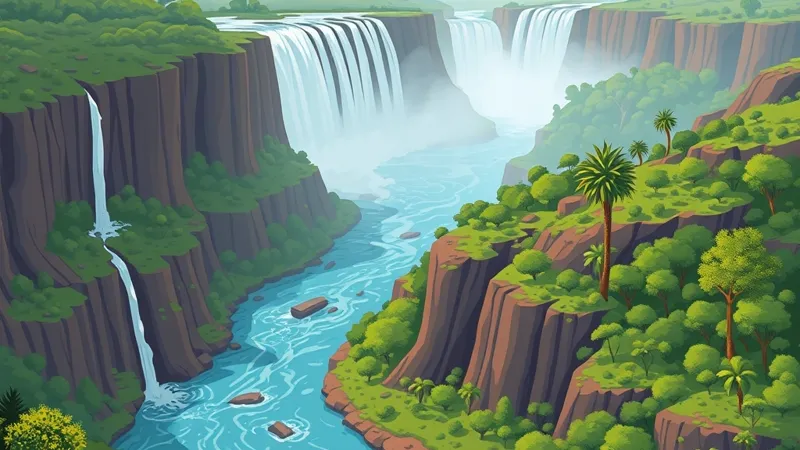
Victoria Falls Landscape: River, Gorges and Rainforest
The Zambezi, basalt gorges and waterfall spray connect the Zimbabwe-side landscape.
Table of Contents
The Victoria Falls landscape connects the Zambezi River, basalt gorges, rising waterfall spray and a rainforest watered by that spray. For readers exploring the Zimbabwe side, these are parts of one landscape: river water falls into the gorge setting, the force of the water sends spray upward, and that spray waters the forest.
What shapes the Victoria Falls landscape?
Three descriptions help explain the connection. UNESCO World Heritage Centre describes water plunging through a series of basalt gorges and raising mist. Zimbabwe Tourism explains that the force of the water drives spray high into the air. ZimParks describes a dense rainforest watered by spray from the Falls.
Together, these accounts connect the river and rock features with the airborne water and forest. The landscape is not just the waterfall: its spray is also part of what sustains the surrounding rainforest.
How do the Zambezi River and basalt gorges define the scene?
The Zambezi provides the river setting; the waterfall and basalt gorges give the landscape its falling-water and rock setting. UNESCO’s description places the plunging water within a series of basalt gorges. That distinction matters when considering the landscape: a river outing and an experience focused on the Falls are not interchangeable.
- River: the Zambezi, the watercourse associated with Victoria Falls.
- Gorges: the basalt rock setting described by UNESCO.
- Spray: water driven into the air by the force of the Falls.
- Rainforest: the dense forest that ZimParks identifies as watered by waterfall spray.
These terms describe different elements of the same scene. Basalt identifies the rock in the gorges; spray and mist describe airborne water rather than another river channel or rock feature.
Why does spray rise above Victoria Falls?
According to Zimbabwe Tourism, the sheer force of the water drives spray high into the air. UNESCO’s account also describes mist rising from the plunging water. Both descriptions make airborne water a central part of the landscape, alongside the river and gorges.
This explains why spray belongs in an account of Victoria Falls geography. It does not establish what a visitor will see on a particular outing, or promise rainbows, clear views or photographic conditions.
How does waterfall spray sustain the rainforest?
ZimParks states that Victoria Falls National Park has a dense rainforest watered by spray from the Falls. The forest therefore belongs in the waterfall’s landscape story rather than being treated as an unrelated attraction: water from the Falls also reaches the vegetation as spray.
The supported connection is straightforward—waterfall spray waters the rainforest. It does not require assumptions about particular plant species, wildlife sightings or trail conditions. The Victoria Falls guided-walk page provides a separate route to information about the walking format.
How do walks, boat outings, helicopter formats and Hwange safaris differ?
Zimbabwe Travel Guide is an independent editorial affiliate guide, not a tour operator. The following formats should be considered separately. Their destination labels do not confirm meeting points, shared departures or a common operator.
- Zimbabwe-side Falls walk: the guided-walk format concerns the Falls rather than a boat or flight experience. Departure base: not established by these sources. Operator option: not established by these sources.
- Zambezi boat outing: the Zambezi sunset-cruise page concerns a river outing, distinct from a Falls walk. Departure base: not established by these sources. Operator option: not established by these sources.
- Helicopter format: the Victoria Falls helicopter page concerns a flight format. The landscape references do not establish flight variants or routes. Departure base: not established by these sources. Operator option: not established by these sources.
- Hwange excursion: the Hwange day-safari page concerns a separate destination excursion, not another format for exploring the Falls rainforest or Zambezi river setting. Departure base: not established by these sources. Operator option: not established by these sources.
FAQ: What should readers know about the Victoria Falls landscape?
What waters the rainforest at Victoria Falls?
Spray from the Falls waters the dense rainforest, according to ZimParks’ description of Victoria Falls National Park.
What rock forms the gorges described by UNESCO?
UNESCO describes basalt gorges. This identifies the rock without establishing a geological age or formation history here.
Why does spray rise above the Falls?
Zimbabwe Tourism explains that the force of the water drives spray high into the air. UNESCO also describes mist associated with the plunging water.
Do walks, boat outings, helicopter trips and Hwange safaris share a departure base or operator?
These are distinct formats. The cited landscape sources do not establish their departure bases or operators, so a shared meeting point or provider should not be assumed.
To explore the formats separately, visit the Zimbabwe Travel Guide tours overview.
Sources
The following supplied research references have summaries dated 14 October 2026. They are dated supporting accounts, not pages independently inspected or live-verified for this article.
- ZimParks: Victoria Falls National Park — supports the description of a dense rainforest watered by spray from the Falls.
- Zimbabwe Tourism: Victoria Falls — Mosi-oa-Tunya — supports the explanation that the force of water drives spray high into the air.
- UNESCO World Heritage Centre: Mosi-oa-Tunya / Victoria Falls — supports the description of water plunging through basalt gorges and raising mist.
These summaries do not establish commercial operators, departure logistics or current visitor conditions.
Before You Go: Quick Planning Checklist
- Check updated weather and operator notices for your travel dates.
- Confirm transfer arrangements and arrival timing.
- Book your tour and hotel with flexible options when possible.
- Read local safety guidance before excursions.